

Most people assume that eating well means logging every gram and hitting an exact daily calorie target. That belief creates more stress than results. Calorie awareness offers a fundamentally different approach: understanding the energy landscape of your food without turning every meal into a math problem. For anyone using a nutrition tracking app to build lasting habits rather than chase perfect numbers, this distinction changes everything about how you relate to food, your body, and your long-term wellness.
Table of Contents
- Defining calorie awareness: What it really means
- How calorie awareness impacts your well-being
- Not all calories are equal: Quality versus quantity
- Applying calorie awareness in real life: Out-of-home choices and app strategies
- Why calorie awareness is a game-changer for wellness, not just weight loss
- Build calorie awareness with smarter app choices
- Frequently asked questions
Key Takeaways
| Point | Details |
|---|---|
| Calorie awareness defined | It means understanding food energy in context, not obsessively counting every calorie. |
| Supports psychological well-being | Flexible calorie awareness reduces stress and risk of disordered eating compared to strict tracking. |
| Food quality matters | Different foods with similar calorie counts can impact satiety and nutrition very differently. |
| App use for awareness | Nutrition apps are most helpful when used to educate and build sustainable, intuitive habits. |
| Awareness in real-life choices | Calorie labels and tracking work best when paired with behavioral skills and mindful eating. |
Defining calorie awareness: What it really means
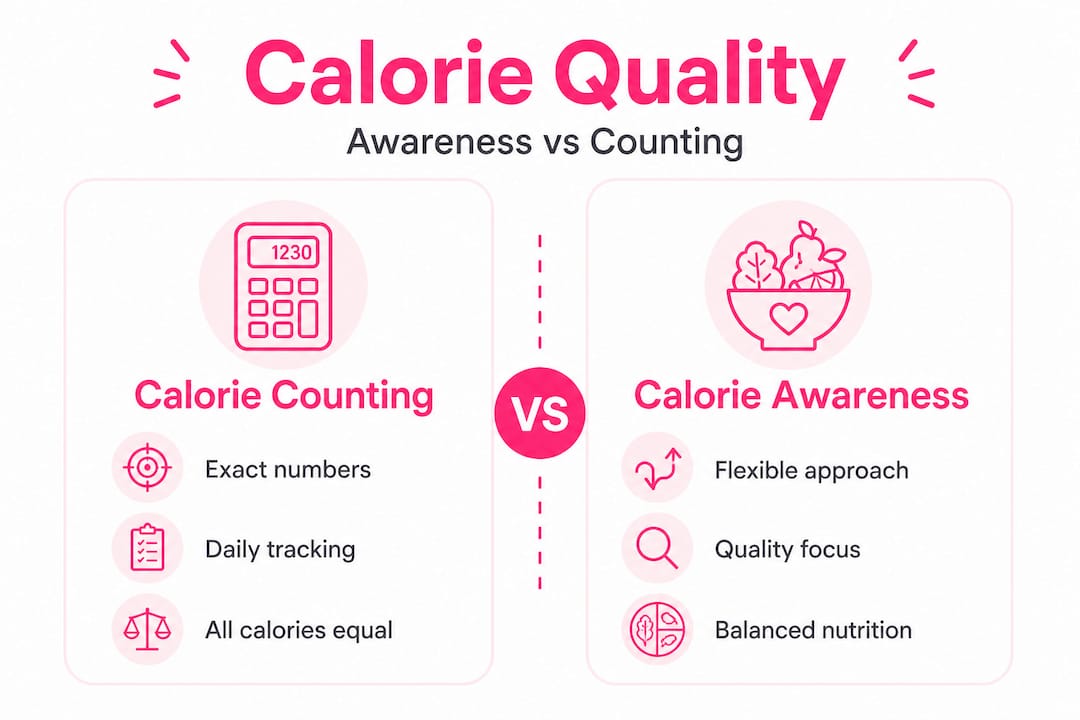
Calorie counting and calorie awareness sound similar, but they operate from completely different mindsets. Calorie counting demands precision: you weigh portions, scan barcodes, and feel anxious if you miss a log entry. Calorie awareness, by contrast, is about building a working knowledge of food energy so you can make informed decisions without obsession.
As Harvard Health describes it, calorie awareness means having a general, practical understanding of the energy content of foods and how that relates to your goals, without obsessively counting every calorie. That framing is important. The goal is not ignorance about calories; it is informed flexibility.
Here is why the distinction matters so much for app users:
- Calorie counting treats food as a ledger. Every entry either helps or hurts your daily "budget."
- Calorie awareness treats food as information. You learn what different meals cost you energetically, and you use that knowledge to guide choices over time.
- Counting requires constant effort. Awareness builds into a skill that eventually runs in the background.
- Counting can create guilt around "going over." Awareness creates curiosity about patterns instead.
"The goal of calorie awareness isn't to stop caring about nutrition. It's to care about it intelligently, using knowledge rather than anxiety as your guide."
The practical value for wellness seekers is significant. When you understand that a large restaurant pasta dish often carries 900 to 1,200 calories, you don't need to log it precisely to make a smarter choice. You already have the context. Calorie awareness tracking apps can accelerate this learning curve dramatically by showing you visual breakdowns, pattern summaries, and portion comparisons that build genuine nutritional literacy rather than dependence on daily totals.
| Feature | Calorie counting | Calorie awareness |
|---|---|---|
| Daily tracking requirement | Strict, every meal | Flexible, pattern-focused |
| Stress level | Often high | Generally low |
| Skill built over time | Data entry | Nutritional intuition |
| Response to missed logs | Anxiety or guilt | Minimal disruption |
| Long-term sustainability | Low for many users | High for most users |
The obsession with exact numbers is often counterproductive for a straightforward reason: calorie estimates are inherently imprecise. Food labels carry a legal margin of error of up to 20 percent in the United States. Restaurant portions vary. Home cooking measurements shift. Chasing a precise number inside a system that cannot deliver precision creates a false sense of control while adding real stress.
How calorie awareness impacts your well-being
The psychological dimension of how you track food is just as important as the nutritional data itself. This is where calorie awareness consistently outperforms rigid counting for most people.

Research makes the stakes clear. Tracking can become harmful when it crosses from useful feedback into obsession, anxiety, or reinforcement of disordered eating patterns. The same app feature that helps one person build healthy habits can push another toward food fear. Psychological outcomes depend entirely on how tracking is used, not just whether it is used.
Calorie awareness sidesteps many of these risks by keeping the focus on learning rather than compliance. Here is what that looks like in practice:
- Mindful eating cues: Instead of stopping when you hit a calorie number, you practice noticing hunger and fullness signals. Your app data becomes a reference point, not a rulebook.
- Portion focus over precision: You develop a feel for what a 400-calorie meal looks like on your plate, rather than needing a scale to confirm it.
- Pattern recognition: Weekly trends matter more than daily totals. One high-calorie day is irrelevant. A consistent pattern of overeating dense foods is worth addressing.
- Reduced food guilt: When you miss a log or eat something unplanned, awareness-based tracking doesn't punish you. You simply note the experience and move on.
Pro Tip: If you notice that opening your tracking app makes you feel anxious rather than informed, that's a signal to shift from counting mode to awareness mode. Use your app to review weekly summaries and food quality trends instead of monitoring daily totals.
"Calorie awareness can overlap with calorie tracking, but psychological outcomes depend on whether tracking becomes obsession, anxiety, or disordered-eating reinforcement." — Psychreg
For practical calorie tracking that supports mental health rather than undermining it, the key is using app data as a teacher rather than a judge. Log meals to learn, not to grade yourself. Review patterns to spot opportunities, not to calculate failures.
Not all calories are equal: Quality versus quantity
Here is the insight that changes how most app users think about their data: two meals with identical calorie counts can have completely different effects on your hunger, energy, and health outcomes. This is not a minor footnote. It is central to why calorie awareness beats pure calorie arithmetic.
Food quality and nutritional content influence satiety and overall diet quality even when calorie counts are similar. A 500-calorie meal of grilled salmon, roasted vegetables, and brown rice will keep you full for hours, deliver fiber, omega-3 fatty acids, and micronutrients, and support stable blood sugar. A 500-calorie serving of chips and a soda will spike your blood sugar, leave you hungry within 90 minutes, and deliver almost no nutritional value.
The practical implications for how you use your tracking app are significant:
- Energy density matters: Foods with high water and fiber content (vegetables, fruits, legumes) deliver fewer calories per gram, meaning larger portions for the same calorie load.
- Protein and satiety: High-protein foods increase fullness hormones and reduce overall intake more effectively than equal-calorie carbohydrate-heavy foods.
- Glycemic impact: Foods that spike blood sugar quickly tend to drive hunger cycles, making calorie control harder even when totals look fine on paper.
- Micronutrient density: Nutrient-rich foods support metabolic function, meaning your body uses energy more efficiently over time.
| Food (500 calories) | Protein | Fiber | Satiety duration | Nutrient density |
|---|---|---|---|---|
| Grilled chicken + vegetables | High | High | 3 to 4 hours | Very high |
| White pasta with butter | Low | Low | 1.5 to 2 hours | Low |
| Mixed nuts | Moderate | Moderate | 3 hours | High |
| Candy and soda | Very low | None | Under 1 hour | Very low |
This is where tracking nutrition quality inside your app becomes genuinely powerful. When your app shows you not just calories but macros, fiber content, glycemic impact, and vitamin breakdown, you stop optimizing for a number and start optimizing for how your body actually feels and functions. That shift is the heart of calorie awareness in practice.
Empty calories, meaning calories from foods with little nutritional value beyond energy, are particularly worth recognizing. Ultra-processed snacks, sugary drinks, and refined carbohydrates can fill your calorie budget while leaving your body undernourished and still hungry. Calorie awareness means recognizing these patterns without needing to obsess over exact gram counts.
Applying calorie awareness in real life: Out-of-home choices and app strategies
Understanding calorie awareness in theory is useful. Applying it when you are at a restaurant, a work lunch, or a social event is where the real skill gets built.
One of the most important nuances to understand is that calorie label information has mixed empirical effects on consumer choice. Simply seeing a calorie number on a menu does not reliably lead to better decisions. Context, hunger state, social environment, and food preferences all influence what people actually order. This is not a failure of the information; it reflects the complexity of real eating behavior.
What this means for you is that calorie awareness is a skill, not a lookup table. Here is how to build it effectively:
- Use your app to calibrate at home first. Log meals you prepare yourself to build a solid reference library. Once you know that your typical dinner plate runs around 600 calories, you have a baseline for estimating restaurant meals.
- Learn the high-density culprits. Oils, sauces, dressings, and cheese add calories quickly and invisibly. A salad with full dressing can easily exceed a burger in calorie content. Knowing this changes how you scan a menu.
- Apply the portion anchor technique. When eating out, mentally compare portions to what you would serve at home. A restaurant pasta portion is often two to three times a standard serving. You don't need to calculate it precisely; you just need to recognize the gap.
- Focus on food composition, not just totals. Choosing a meal with protein, vegetables, and whole grains over a refined-carb-heavy option is a calorie-aware decision even without a single number in mind.
- Review, don't obsess. After eating out, log a rough estimate in your app to maintain pattern awareness. Precision is not the goal; consistency of learning is.
Pro Tip: Before dining out, spend 60 seconds scanning the restaurant's online menu through your app. Most major chains have calorie data available. You will walk in with context rather than guessing, which makes calorie-aware choices feel effortless rather than restrictive.
Tracking apps also carry a responsibility around the data they collect. Reviewing privacy practices in nutrition apps before committing to a platform is a smart step, especially when you are sharing detailed meal logs and health metrics. Your wellness data should work for you, not be monetized against you.
The Numi app for calorie awareness takes a different approach by using AI-powered food recognition from photos, so you build awareness through visual learning rather than manual data entry. That design choice reinforces the skill-building model rather than the compliance model.
Why calorie awareness is a game-changer for wellness, not just weight loss
Here is the perspective that most nutrition content misses entirely: calorie awareness is not a softer version of calorie counting. It is a fundamentally more sophisticated skill.
Most app users start their wellness journey focused on numbers because numbers feel controllable. Hit your calorie target, lose weight. Exceed it, feel bad. That framework is understandable, but it treats your body like a simple calculator and ignores the enormous complexity of metabolism, hunger hormones, sleep quality, stress, and food composition.
The users who see lasting results are the ones who transition from compliance to competence. They use their apps to learn, not to obey. As Harvard Health notes, a calorie-aware approach means using your app to teach and calibrate your estimates around portion size, food energy density, and patterns over time, then gradually reducing reliance so you can respond to hunger and satiety cues rather than rigid daily targets.
That transition is the real goal. When calorie awareness becomes internalized, you stop needing to log every meal to eat well. You have built the skill. The app has done its job.
This matters for wellness beyond weight loss because it changes your relationship with food permanently. Anxiety around eating drops. Social meals become enjoyable again. You make better choices not because a number tells you to, but because you genuinely understand what different foods do to your energy, hunger, and mood. That is a wellness outcome no calorie target can deliver on its own.
Calorie awareness with Numi is built around exactly this philosophy: use AI-driven insights to accelerate your learning curve, build genuine nutritional intuition, and develop habits that outlast any tracking streak.
Build calorie awareness with smarter app choices
Calorie awareness is a skill worth building, and the right tool makes all the difference in how quickly and sustainably you develop it.
Numi's AI-powered calorie-aware tracking removes the friction that makes traditional logging feel like a chore. Snap a photo of your meal and Numi's computer vision identifies food items, estimates portions, and delivers detailed insights on calories, macros, vitamins, and glycemic impact automatically. No barcode scanning. No manual entry. No stress. You get the nutritional context you need to build awareness without the obsessive number-chasing that undermines it. Numi also takes your data seriously, with clear privacy commitments that keep your health information secure and working entirely in your favor.
Frequently asked questions
How is calorie awareness different from calorie counting?
Calorie awareness builds a flexible, practical understanding of food energy relative to your goals, while calorie counting requires precise daily tracking of every meal. Awareness scales into an intuitive skill; counting tends to stay effortful indefinitely.
Is calorie awareness safer for people with eating disorder risk?
Yes, calorie awareness using portion cues and flexible habits is generally safer than strict numeric tracking, since rigid calorie tracking can reinforce anxiety and disordered eating patterns in vulnerable individuals.
Can menu calorie labels help make healthier choices?
Menu calorie labels increase nutritional context but don't reliably improve choices for most people, since real eating decisions are shaped by hunger, environment, and habits more than information alone.
How can I use my nutrition app for calorie awareness?
Use your app to estimate and calibrate portion sizes and food energy density over time, then gradually shift toward responding to hunger and satiety cues rather than hitting a precise daily number.